
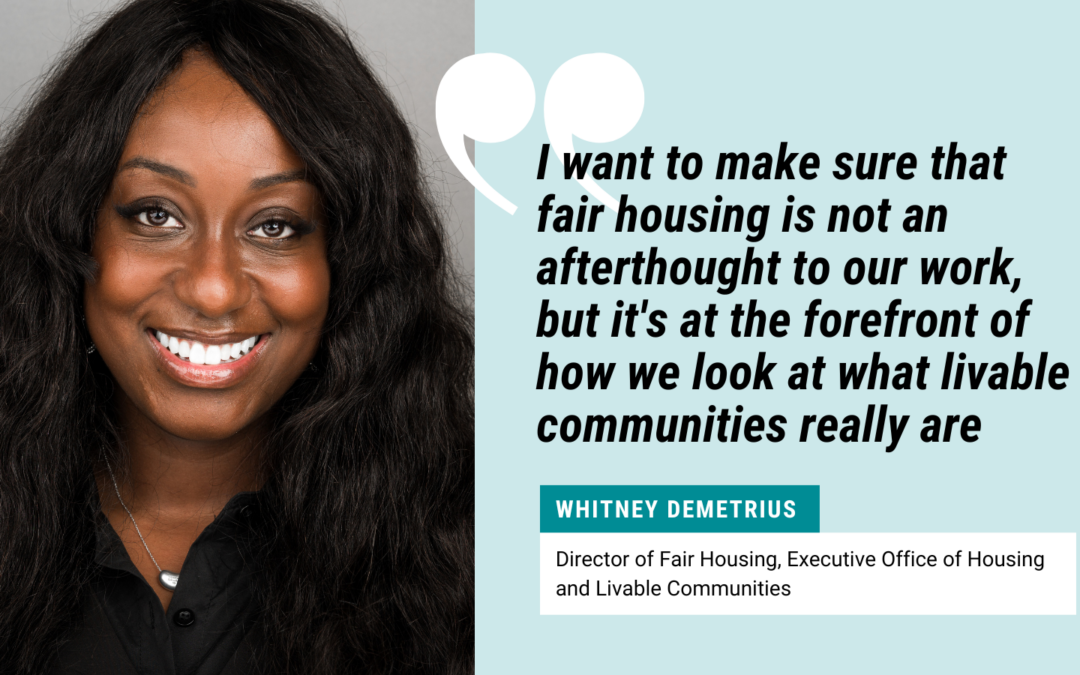
April is Fair Housing Month, and ABCDC wants to make sure everyone knows their fair housing rights and resources available across the Commonwealth. Governor Healey’s Affordable Housing Act prompted the creation of the Office of Fair Housing at the Executive Office of Housing and Livable Communities (HLC). We sat down with the Director of Fair Housing, Whitney Demetrius, to learn more about this new office and how residents can use this new resource.
Governor Healey’s Affordable Housing Act prompted the creation of the Fair Housing Office. What is the role of the office and what are the kind of primary things that the office does?
The Office’s role is to ensure that HLC is incorporating fair housing into all of our work. HLC talks about building better and faster, but we also have to say if we can build, it needs to be accessible to everyone. Every community should be a community of opportunity, and how we do that is to make sure that fair housing is at the forefront.
My role is to have a high-level approach to support the activities that are happening throughout the Commonwealth. The Office is at the intersection of policy and people, and we support education and outreach, enforcement, and strategies that proactively further fair housing and its work. How we do that is by working with our partners, both at the Attorney General’s Office, as well as the Massachusetts Commission Against Discrimination, to enforce the law We also work with local partners and nonprofits who are on the ground helping residents and doing this work each day supporting residents through legal representation, fair housing testing and enforcement, education and training, and other direct services that help uphold fair housing rights.
I want to be in every room and engaging with everyone as it pertains to the priorities that come out of our office, the programs, and certainly the resources that come out of our office. Fair housing has so many intersections like transportation, education, environmental justice, and health care. My responsibility and role are to work to identify and highlight the history of housing discrimination; and work to figure out what it means to remedy and redress it properly. Understanding the history that shaped our current housing landscape, including longstanding patterns of segregation, is essential to developing effective strategies and solutions that move us toward more equitable communities.
The goal of the Office is to work to eliminate housing discrimination and promote open, inclusive, and welcoming communities in all 351 cities and towns. I want to make sure that fair housing is not an afterthought to our work, but it’s at the forefront of how we look at what livable communities really are.
How does the fair housing office not just work with the larger goals of EOHLC, but support those goals as well?
The creation of a dedicated fair housing office is a testament to how seriously this Administration takes this work. The Healey-Driscoll Administration has taken a strong position and created an office designated to address fair housing, and we have a lot of strong leadership that are fair housing advocates. HLC’s new Secretary Juana Matiaswas previously the New England regional director of the US Department of Housing and Urban Development, so she understands how fair housing policy can impact local communities. She enters this roll in as a strong fair housing advocate. That matters.
The Fair Housing Office not only aligns with the broader goals of HLC, but actively supports and strengthens them. Under her leadership, there is a real opportunity to ensure that every division is integrating fair housing into its work and using our office as a resource and sounding board to stay on track. This approach helps ensure we are centering the needs of those most vulnerable, particularly protected classes, and taking more proactive, thoughtful steps in how we respond and shape policy.
The Fair Housing Office has been hosting Fair Housing Regional Listening Sessions since November 2025. What are some of the main concerns people have brought to these listening sessions, and what are FHO’s recommendations/methods of addressing these concerns?
We held thirteen listening sessions and engaged over 1000 residents and stakeholders with the help of our amazing partners across the state. We tried to be really intentional around making sure that we were in every region across the state, so that we can be in the community for a number of reasons. One, so that people know there is an office of fair housing and that they should use us as a resource. Also, so that people know—especially in this climate —that the state of Massachusetts remains committed to fair housing. We’ve had fair housing laws on the books since 1946, even before the Federal Fair Housing Act was passed!
A lot of great information came from those listening sessions, but something that we kept hearing was that people want more education and outreach. People need to know their rights, and we need to think about creative ways to make sure that housing providers, landlords, renters, and homebuyers all understand their rights and responsibilities.
For example, let’s say a first-time homebuyer purchases a two-family home and rents their first floor. They are now a landlord and are under obligations to follow the law. We want to provide preventative education so that homeowner doesn’t say “sorry, you have a child and the house is not de-leaded. I can’t rent to you.” If they know this is illegal through education, this discrimination won’t come up in the first place.
We also heard clearly from residents that, in addition to education, there is a strong desire to ensure compliance through more robust and consistent enforcement of fair housing laws. This underscores the need for a balanced approach that not only informs and empowers communities, but also holds systems accountable and reinforces that these protections must be meaningfully upheld.
The other piece that we heard loudly was the issue of affordability. While affordability is not directly a fair housing issue, it certainly has implications and can be a barrier to fair housing opportunities in communities. If folks have a rental voucher or have children or a disability, the amount of housing available for those populations becomes smaller if there’s only so many housing options that are affordable. And even if they do find a place they can afford, does this mean that they can live safely and comfortably and access the full community?
What is the Fair Housing Trust Fund being used for? What are some examples of the enforcement initiatives, fair housing testing, education, and outreach the FHO is doing?
The Fair Housing Trust Fund was established by the Affordable Housing Act and the Governor secured an initial $1 million for the Fund. This money was then made available to organizations and municipalities across Massachusetts through a Notice of Funding Availability (NOFA) that was published in February of this year.
Funds will soon be awarded to support organizations that address issues around housing discrimination through a broad range of activities including enforcement, testing, education and outreach, furthering fair housing, as well as special projects. These special projects could fund something like a Fair Housing Testing Study. That is like ‘mystery shopping’ in the housing market to help uncover what’s happening on the ground as pertains to fair housing and protected classes. We are in the midst of reviewing proposals and I’m excited to soon be able to announce the awardees.
What recommendations do you have for Massachusetts residents looking to get more involved with fair housing advocacy in their communities?
I love this idea of advocates wanting to be more intentional around doing work locally around fair housing. There’s so much to be done and so many good models for doing so!
First, there are local human rights commissions, like the Cambridge Human Rights Commission or the City of Boston Office of Fair Housing and Equity, and you can get involved to help support some of the work they are doing on the ground.
Also, the Fair Housing Alliance of Massachusetts is a group of four organizations that work to end housing discrimination through legal services and education. These organizations are Community Legal Aid, the Massachusetts Fair Housing Center, SouthCoast Fair Housing, and Suffolk Law Center for Housing Justice & Policy. Those agencies do testing and they send out ‘mystery shoppers’ in the housing market to pull together reports to determine if discrimination is occurring, and you can sign up to be one of those people. They will train you and give you a stipend for your time, and you will be working in a real way to uncover discrimination. Often times, you don’t even know the impact that you make as a tester, but it can be making a family housed. It could be making a family whole who was steered away from a community because of their disability. It’s impactful work and it’s meaningful work and there’s always a need for more testers.
Something else that is happening on the ground are local housing coalitions that have popped up over the last few years. Citizens’ Housing and Planning Association’s Municipal Engagement Initiative provides technical assistance to residents and stakeholders to support local advocacy for affordable housing, shift the conversation, and help create healthy, equitable, affordable, and vibrant communities. These groups of residents care about housing in their community and come together and discuss what it means for a community to be welcoming. There are also groups like the Needham Housing Coalition or Revere Housing Coalition where you can get involved or otherwise establish a similar group in the community you live in.
The role local fair housing committees and commissions play a critical role in implementing fair housing strategies within a municipality. If your community does not have a local fair housing commission or committee, you could start one! You can tap into agencies like Metropolitan Area Planning Council that have resources to help you figure out how to start this catalyst in your community. Many municipalities in our state used to have Fair Housing Committees, but many of them haven’t been active in the past 10 or 15 years. There’s been a push to revive these committees, and both Somerville and Newton have active organizations. Reach out and ask them how they were formed and how they set their priorities. Those groups are great examples of how you can get involved in your own community.
Affordable housing trusts also play an important role in advancing fair housing by supporting the development and preservation of affordable homes and expanding access to equal housing opportunities. Engaging in these efforts at the local level strengthens community driven work.
It is important that we not only look to strong models but also remain creative and intentional in how we get involved and drive meaningful change.
For more information about the Office of Fair Housing, visit their website today: https://www.mass.gov/info-details/the-office-of-fair-housing